Abstract
This study investigated whether individuals from urban, suburban, and rural environments differ in their friendliness toward strangers. It is commonly believed that people from urban areas behave less warmly toward strangers compared to those from suburban or rural environments. The hypothesis predicted that individuals who had lived longer in urban environments would be less likely to behave friendly toward strangers, while those who had lived longer in rural environments would be more likely to display friendliness. Data were collected through a questionnaire measuring participants’ self-reported friendliness toward strangers. Results indicated a slight visual trend of decreased friendliness-related responses as the number of years living in the same environment increased, although most findings were not statistically significant. Several limitations of the study, including sample size and methodology, suggest that future research with improved design may produce clearer results.
Introduction
It is generally believed that individuals living in different environments behave according to the social context of where they live. For example, in dense urban cities such as New York, strangers are often less likely to interact with one another, while in smaller communities and towns, engaging with strangers is more common and may contribute to community building. In this sense, social behaviors may be influenced by the environment in which individuals live.
This study investigated friendliness toward strangers across three types of living environments: urban, suburban, and rural. The purpose of the study was to better understand how social behaviors vary across different environments. Participants were also asked how long they had lived in their current location in order to examine whether the length of time spent in an environment influences behavior as individuals adapt to their surroundings.
Methods & Materials
The study was conducted using an anonymous online survey created through Google Forms, and participation was voluntary. A total of 30 participants completed the survey over a period of approximately one and a half weeks. The questionnaire asked participants to report their age, the type of environment in which they lived (urban, suburban, or rural), and how long they had lived in that location. Participants were also presented with survey statements designed to measure friendliness toward strangers. Responses were recorded using a 5-point Likert scale. Depending on the question, a response of 1 represented either “strongly disagree” or “never,” while a response of 5 represented either “strongly agree” or “always.”
Results
The results were inconclusive due to limitations in the data collected. Participant distribution across location categories was uneven, with urban participants making up the largest group (n = 17), followed by suburban participants (n = 11) and rural participants (n = 2) as shown in figure 1. Additionally, there was limited variation in the number of years participants had lived in their current environment, with many participants clustered in the urban 9+ years category.
Overall, the results as shown in figure 2 suggested a slight decrease in participant responses as the number of years living in the same environment increased, regardless of location category. However, most results were not statistically significant. The only statistically significant trend was found among participants who had lived in urban environments for more than nine years, where responses indicated they were less likely to initiate conversations with strangers.
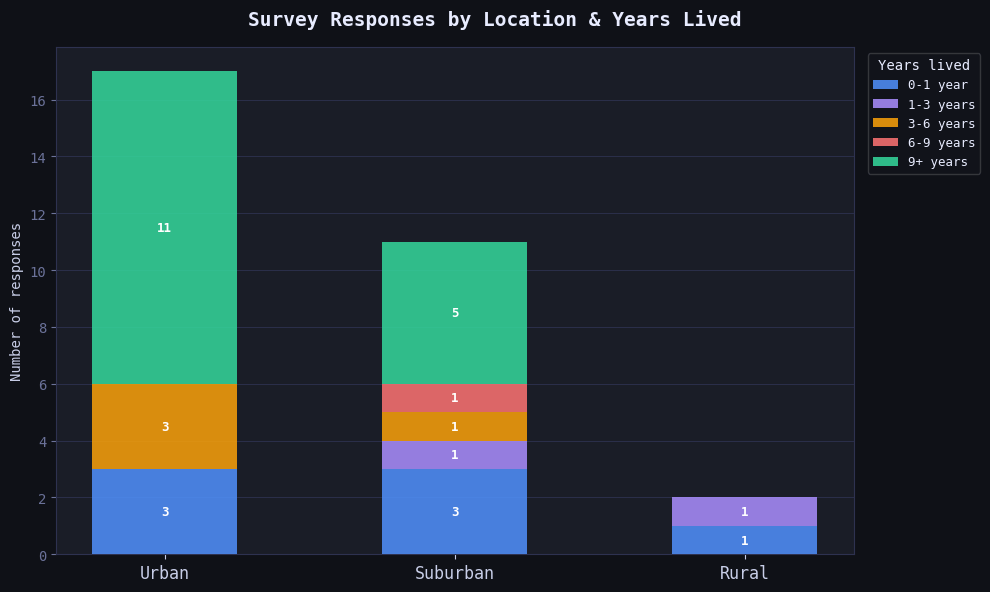
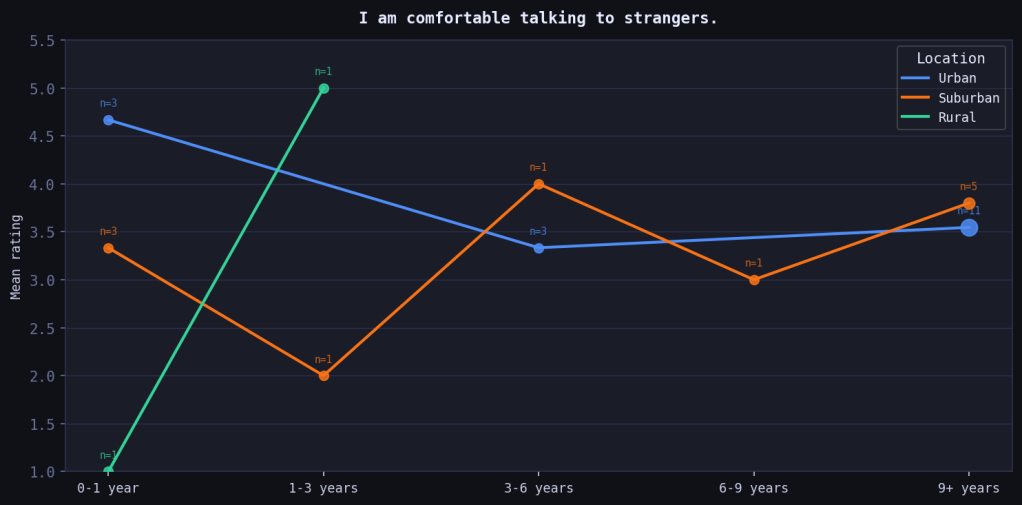
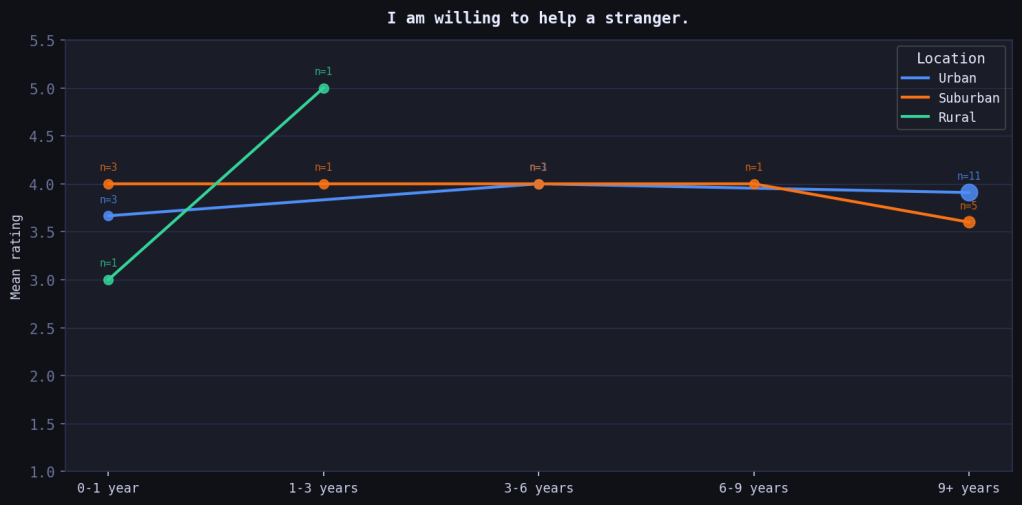
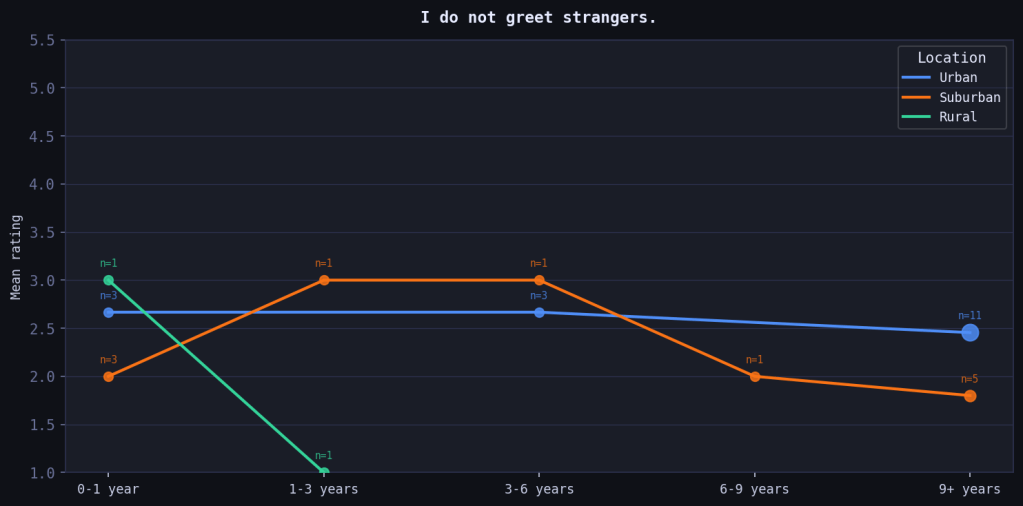
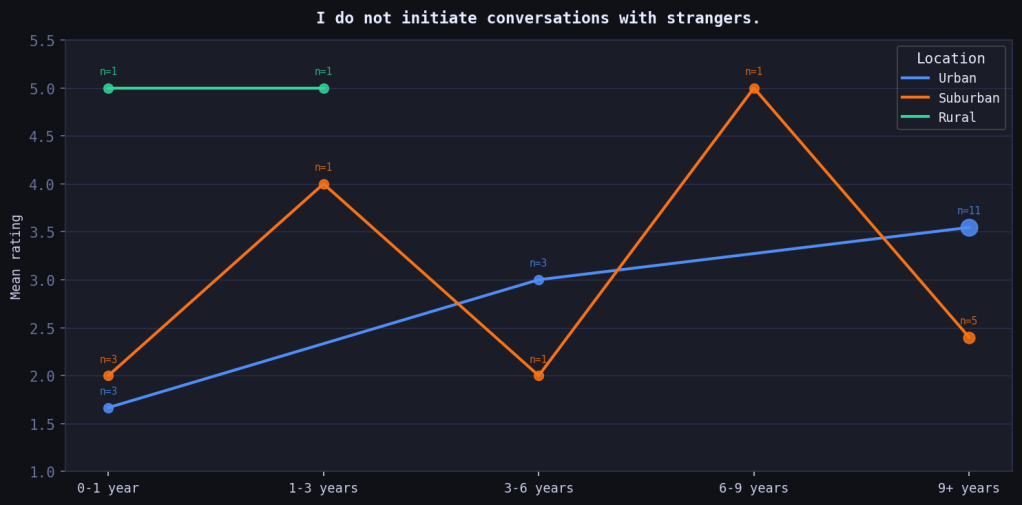
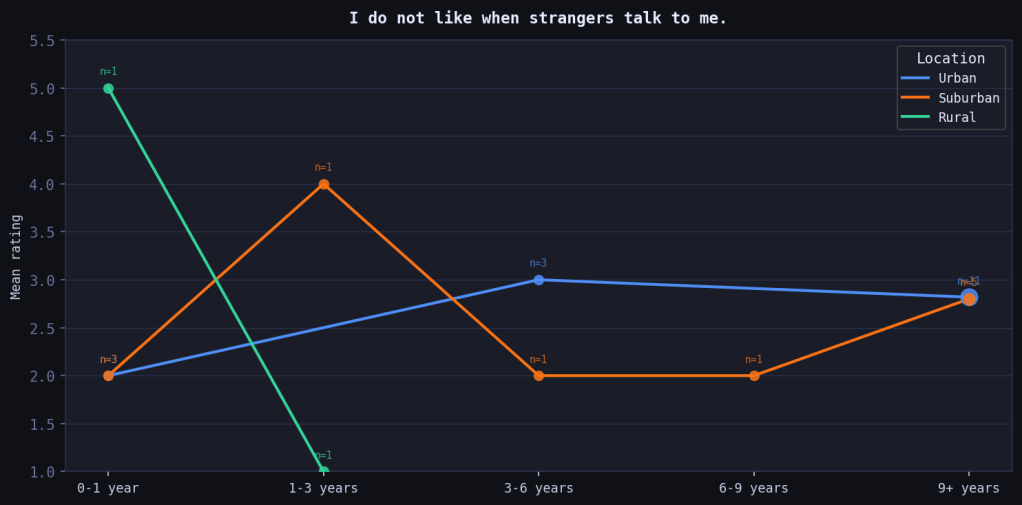
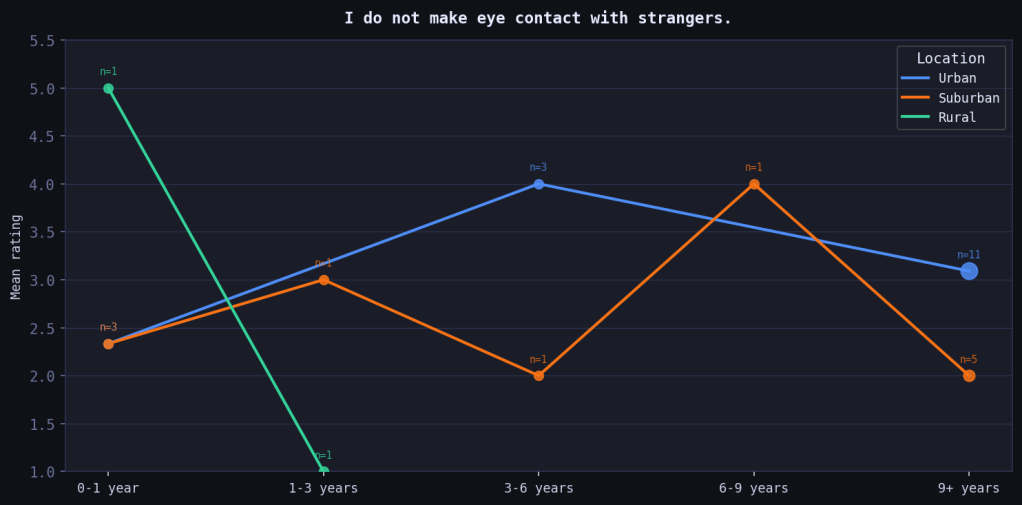
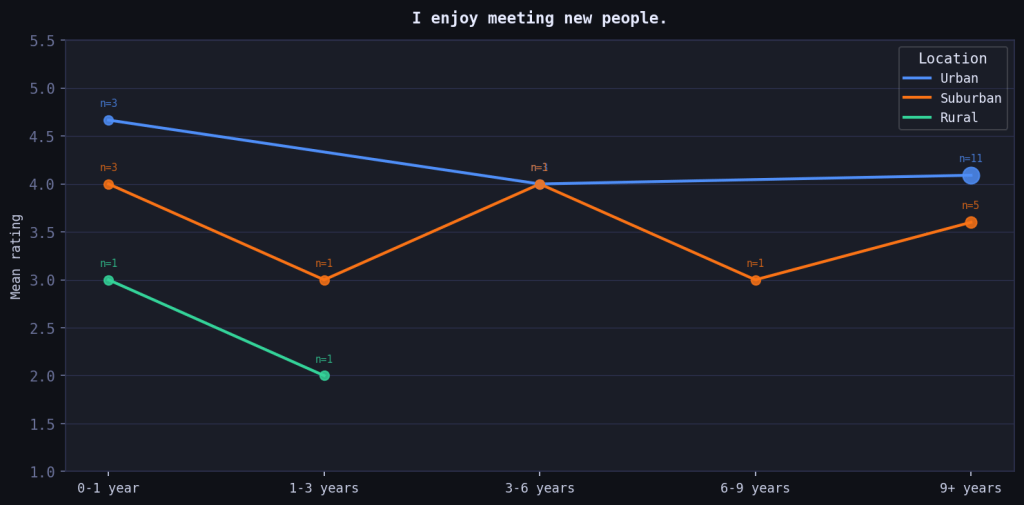
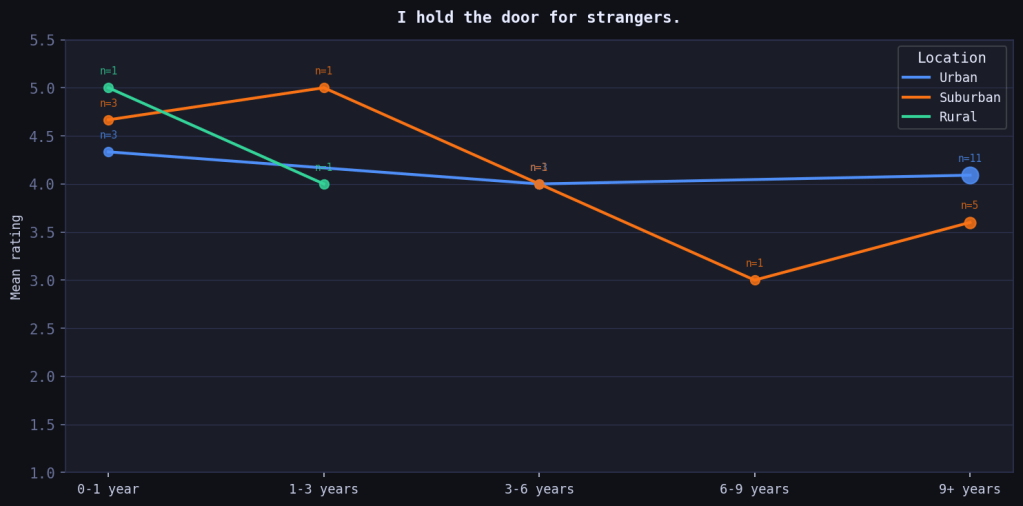
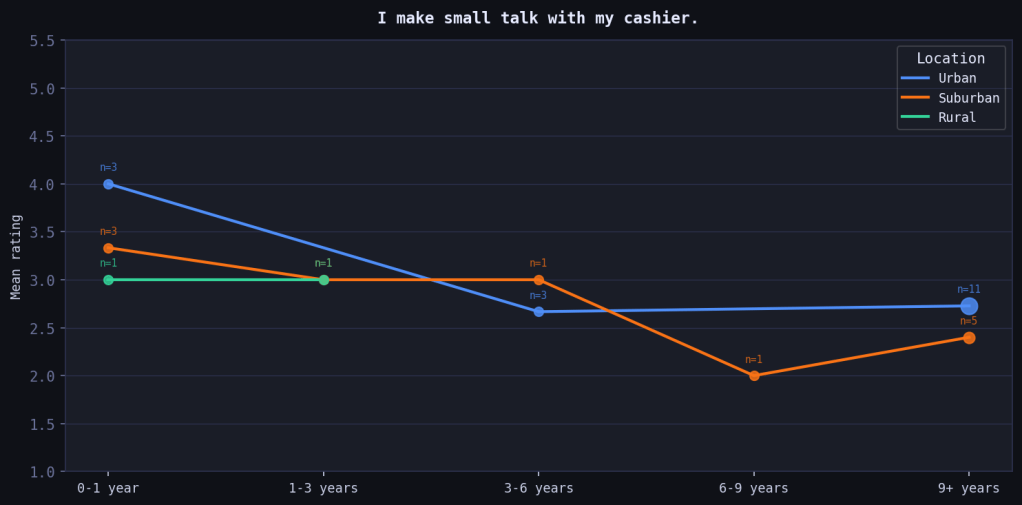
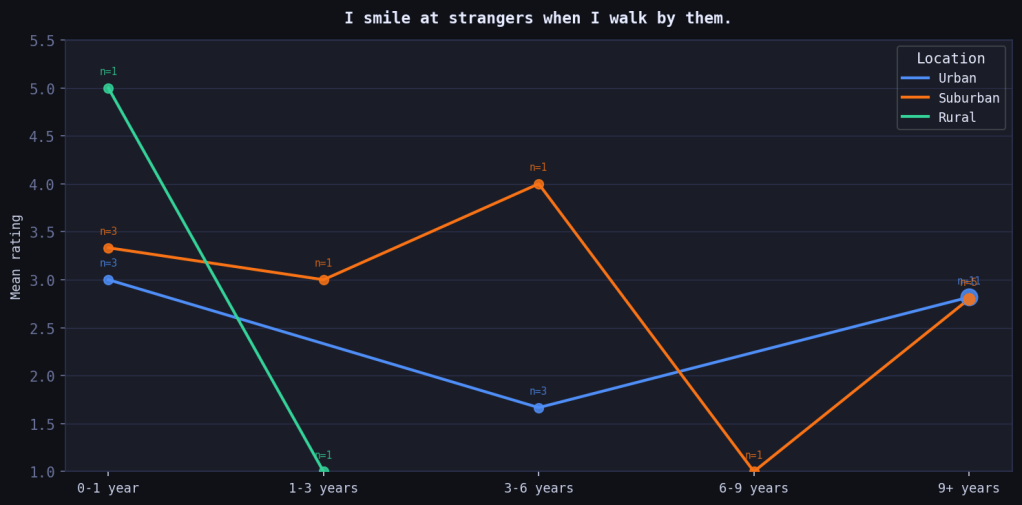
Figure 2. Trends in participant responses as the number of years living in the same environment increased.
Discussion & Limitations
Several limitations may have affected the findings of the study. First, the uneven participant distribution across urban, suburban, and rural categories limited the ability to accurately compare groups. The very small rural sample size, in particular, prevented meaningful statistical analysis for that category.
In addition, the survey statements may have had limited construct validity in measuring friendliness toward strangers. Certain statements, such as “I hold the door for strangers” and “I am willing to help a stranger,” may reflect general social courtesy or social expectations rather than friendliness itself. As a result, some survey items may not have fully captured the intended behavior being studied.
Although the visual trend in the data was not statistically significant, it may suggest the presence of lurking or confounding variables. For example, individuals who have lived in one environment for a long period of time may already feel socially established in their community and therefore may feel less need to interact with strangers. In addition, personality traits such as introversion may also influence willingness to engage with strangers regardless of living environment.
The sampling method may have also introduced bias. Because the questionnaire was distributed online, individuals who do not use the platforms on which the survey was shared or who have limited access to technology may have been excluded from participation. This may have affected the diversity and representativeness of the sample.
The survey itself could also be improved by asking participants about the type of environment in which they have spent the majority of their lives rather than only asking about their current environment and the number of years spent there. In addition, differing personal definitions and social contexts may have affected how participants interpreted survey statements. For example, the statement “I do not like when strangers talk to me” may have been interpreted by some participants as relating to personal safety, annoyance, or social boundaries rather than a lack of friendliness.
Future studies could improve upon these limitations by recruiting a larger and more balanced sample across all living environments, using survey items with stronger construct validity, and expanding recruitment methods beyond online platforms to reach a wider population.
_________________________________________________________
Codebook
Public Interaction and Living Environments
Tuesday, May 19, 2026
Method: Google Forms Questionnaire
Scales:
Never – Always
1 = Never
2 = Sometimes
3 = Often
4 = Frequently
5 = Always
Strongly Disagree – Strongly Agree
1 = Strongly Disagree
2 = Disagree
3 = Neutral
4 = Agree
5 = Strongly Agree
| Variable | Values | High Values Indicate | Variable Type |
| age | Open Numeric Response | continuous | |
| gender | 1 = Male 2 = Female 3 = Other | nominal | |
| residence_area | 1 = Urban 2 = Suburban 3 = Rural | nominal | |
| residence_duration | 1 = 0-1 years 2 = 1-3 years 3 = 3-6 years 4 = 6-9 years 5 = 9+ years | ordinal | |
| smile_strangers | Never – Always | Social Engagement | ordinal |
| hold_door_strangers | Never – Always | Social Engagement | ordinal |
| not_greet_strangers | Never – Always | Social Avoidance | ordinal |
| small_talk_cashier | Never – Always | Social Engagement | ordinal |
| no_eye_contact_strangers | Never – Always | Social Avoidance | ordinal |
| meeting_new_people | Strongly Disagree – Strongly Agree | Social Engagement | ordinal |
| dislike_strangers_talk_me | Strongly Disagree – Strongly Agree | Social Avoidance | ordinal |
| comfort_talk_strangers | Strongly Disagree – Strongly Agree | Social Engagement | ordinal |
| help_stranger | Strongly Disagree – Strongly Agree | Social Engagement | ordinal |
| not_initiate_talk_strangers | Strongly Disagree – Strongly Agree | Social Avoidance | ordinal |
Missing Data Codes
| Code | Meaning |
| 99 | Missing Value |
LINK TO THE CLAUDE CHAT I USED TO GENERATE THE CHARTS:
https://claude.ai/share/4a4bf548-dbb3-42d2-869e-1823e0dc6aaf
LINK TO THE GOOGLE COLAB I MADE TO RUN THE CODE:
https://colab.research.google.com/drive/1aaG9piN9Yn2xtrpB752NAKLzsbASYALU?usp=sharing

